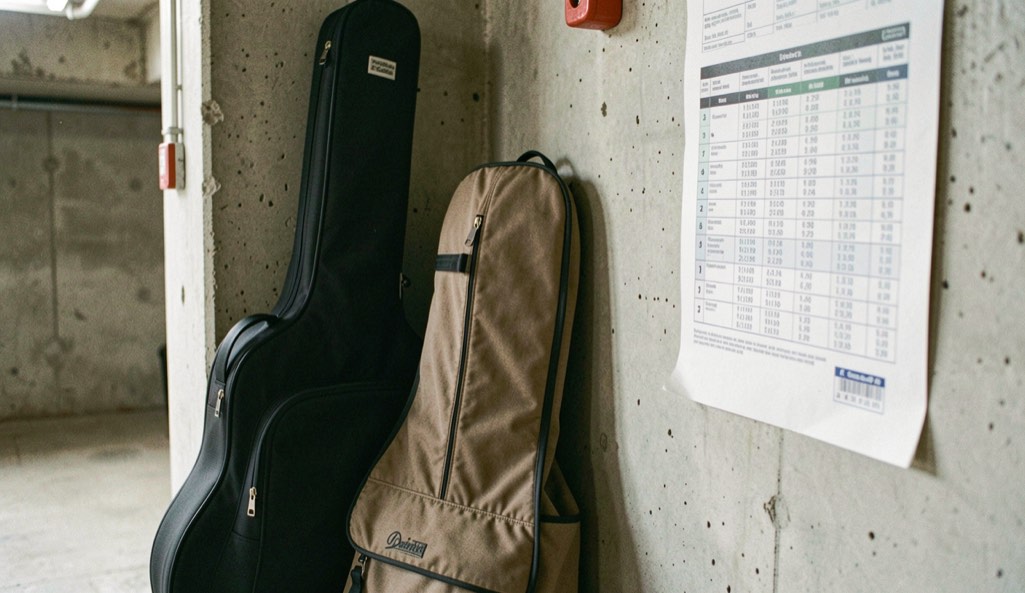
A show that fits in two bags is not a smaller show. It is the same show with the weight question settled before packing starts: one bag is the instrument, the other is everything else, and the everything-else bag has to close without forcing. Every object that makes the trip answers one question first, and the answer decides its place in a bag or its place at home.
The question that weighs every object
The test is not whether a thing is useful; the test is whether the last row would notice its absence. If an object stayed at home and the last row lost nothing, it does not travel, however small it is. If the last row would lose a verse, a tuning or a saved set, the object travels in whichever bag protects it. The desk applies the test to four groups, and the fourth saves the most weight, because it does not travel at all.
The first bag's passenger is the instrument that carries the songs. The melodica passes this test well: held in the hands, sounded by blowing through a mouthpiece, with a keyboard of usually two or three octaves, it is a full set's range in one passenger's carry. What that range does to a quiet room is the subject of how a reed instrument sounds; here it matters only as the first bag's passenger.
| Object | What the last row hears from it | What the house supplies | Which bag |
|---|---|---|---|
| The instrument that carries the songs | Every chord and every held note | A stool and a lamp | The first bag |
| A second voice, or nothing | The answer phrase on two songs a night | Somewhere to rest it between uses | The first bag |
| The silent kit: spare strings, a tuner, a capo, a pencil, the set list, a cloth | Nothing, until something breaks or detunes | A small table to lay it on | The second bag |
| The stool, the table, the lamp, the glass of water | Nothing, and the room works better | Already in the building | No bag at all |
What can the house be asked for, and when?
Everything in the fourth row belongs to the building, and none of it can be conjured on the night. The ask is four lines: a chair or a stool, a small table, a lamp, a glass of water. The desk sends it when the booking is confirmed, because that is the last moment a house can say no without embarrassment, and the first moment the request costs nothing to grant. A house asked early has already started on what the house controls, and the case is the same one with more at stake.
Batteries and liquids ride in the cabin
Part of the second bag has rules of its own, and they are not the performer's to bend. Lithium-powered devices and spare batteries, which covers the tuner, the phone and any lamp that travels, go in hand baggage only. If the cabin bag is taken at the gate and placed in the hold, the batteries come out first, so pack them where a hand can reach without unpacking the instrument. Anything liquid, valve oil or a small bottle, travels in containers of 100 ml at most, inside a transparent resealable bag of one litre.
Weight and size limits are the part no page can state once: they vary with the airline, the cabin class and even the aircraft. The IATA baggage page makes the same point from the other side: the airline sets the rules, and the traveller checks them with the carrier for the trip. The desk's habit is to copy the carrier's numbers onto the set list, beside the two weights from the bathroom scale. A limit only works when it is written where the packing happens.
What does four minutes of unpacking cost?
Weight is one budget; minutes are the other. The desk's arithmetic: a twenty-minute slot, the kind described in the shape of a short set, stays intact when the unpacking runs under four minutes. Past four, the minutes come off the music, and they usually come off the last song, which is the one a quiet set is built around. The count is made at home, with a stopwatch, unpacking from the bags exactly as they will arrive: instrument out first, silent kit to the table, then whatever tuning the first song needs. Four minutes is not a guess; it is a rehearsal count, and it improves the way rehearsed things do.
The night before the flight
Five gestures, none of them possible at the airport:
- Weigh both bags on the bathroom scale and write the two numbers at the top of the set list.
- Open the carrier's own baggage page for this trip and copy its weight and size limits beside them.
- Move the tuner, the phone, the lamp and any spare battery into the cabin bag, and stand the small bottle in the transparent bag.
- Run the stopwatch once, unpacking in the order the set needs, and pack back the same way.
- Send the house the four-line ask if it has not gone: stool, small table, lamp, glass of water.
Sources
- IATA, "Baggage", the IATA baggage page, consulted 5 September 2026.
- Wikipedia, article "Melodica", Melodica, consulted 5 September 2026.
- The worked examples are the desk's own arithmetic, redoable from the assumptions above.