Room 02 · The writing
The writing: songwriting for a quiet room
Writing for a room where every word arrives: the four line verse as a working unit, and the plain test of the back row.
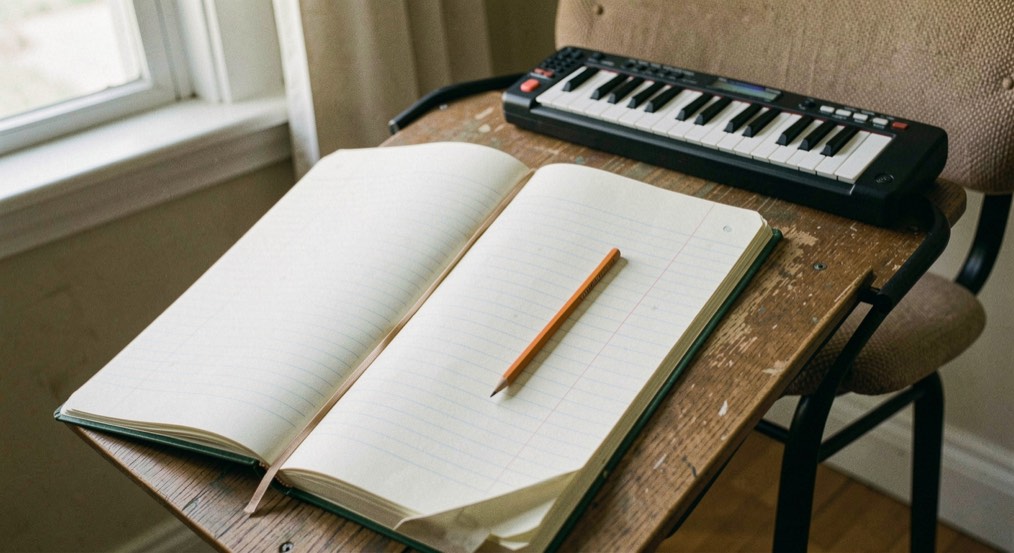
A quiet room removes the two things that hide a weak lyric: volume and distance. Forty people at three metres hear the line, hear the breath before it, and hear whether the last word of the verse was worth waiting for. Writing for that room is not a genre, it is a set of constraints, and the constraints are worth writing down.
The notes in this room work on the sentence and on the shape. One takes the four line verse apart and shows why it carries so much of the repertoire of the small-room show. The other is a test rather than an essay: sit at the back, and find out which words survive the trip.
Examples are built, never borrowed
Every verse quoted in this room was written by the desk for the article that uses it. The review quotes no published song and names no writer, so the examples are plain and disposable on purpose: they exist to show a mechanism, not to be admired.
Room 02
In this room
The notes of this room, most recent first.
-
· The writing
Rebuilding a warship's year from the paper trail
A ship's year is rebuilt by reading two kinds of record against each other: the deck log, which gives the day, the position, the weather and the events, and the muster roll, which gives the people.
-
· The writing
The paper trail behind a song
A song leaves more paper than sound. Theatre programmes, session sheets, tape boxes and pressings record dates, rooms, personnel and sequence numbers that a sleeve note never carries, and those documents are what allow a recording to be che
-
· The writing
Reading war memorials and the routes behind the names
A war memorial is a list before it is a monument, and the list has rules.
-
· The writing
Reading the Papers Before a Puppy
A pedigree and a health test are read as two separate documents, and neither one is a guarantee.
-

· The writing
Writing for the back of the room
The listener on the last chair is not a quieter version of the one at the front; they hear a different show. This note works the distance arithmetic, runs a two-pass test for lost words, and rewrites a line so its sense arrives.
-
· The writing
The four line verse that carries a whole song
What the folk ballad's four line stanza offers a small room: eight and six syllables, one rhyme per verse, short lines that leave a breath. The note takes the form apart, line by line, and times three verses.
Two neighbouring rooms carry the same question further: The set and The instrument. How the desk works is written in the editorial policy.