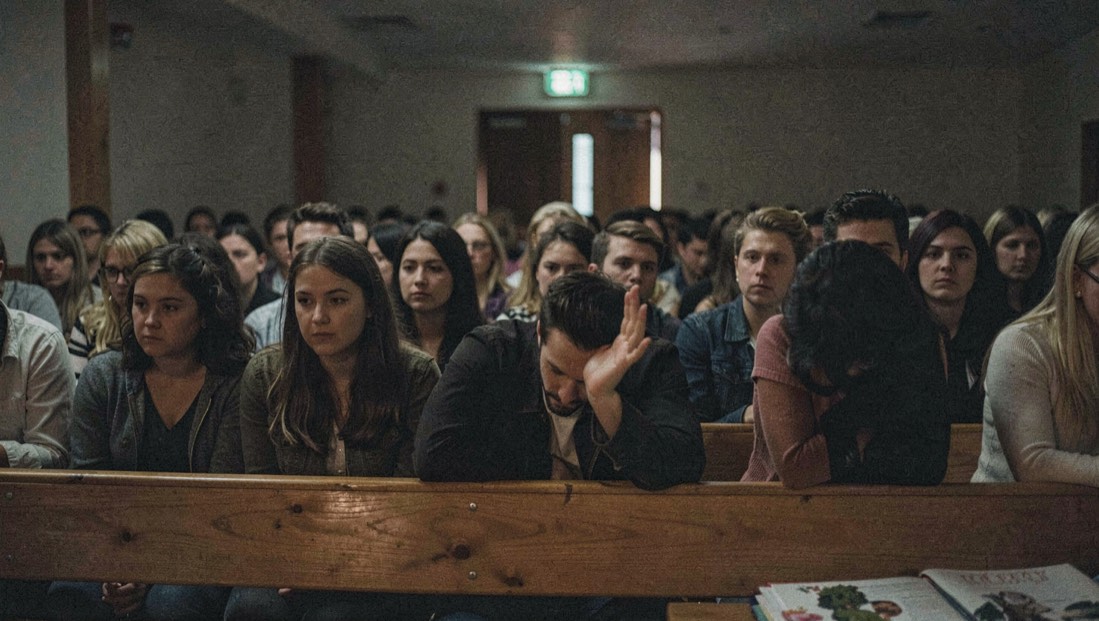
A quiet ending is not a performance decision. It is a property of the building and of the people running it on the night, and a performer who plans one without asking the house is planning something the house has already ruled out. The useful work happens before the doors open, and it takes about ten minutes.
The noise floor is a place, not a mood
Every room has a level below which nothing can be heard, set by whatever is running when nobody is playing: ventilation, a fridge compressor, the coffee machine, the till, the street through a single glazed window, and the bar itself. That floor is what a whispered last verse has to clear. It is also the number most rarely written down, because it is invisible to everyone who works in the room every day and stopped hearing it years ago.
You can compare rooms without instruments, and you should be careful about pretending otherwise. A telephone sound level application is not calibrated and its absolute readings mean little, but the same phone, in the same position, before and after a compressor cycles, gives a difference that is worth having. Take the reading from the last row rather than the stage, because that is where the margin is smallest.
The inventory
The point of an inventory is that each line has an owner. A performer cannot switch off a fridge, but the person holding the keys can, and will, if asked at six o'clock rather than during the encore.
| Source | When it bites | Who can stop it | Cost of asking |
|---|---|---|---|
| Fridge or ice machine | Cycles on without warning | Staff with the plug | None if switched before the doors, a warm bar if forgotten |
| Espresso machine and grinder | Every order at the bar | Whoever is serving | Real: it is the takings of the last twenty minutes |
| Ventilation or heating | Thermostat, so unpredictable | Building manager | A cold room by the second half |
| Street door | Latecomers and smokers | Anyone standing near it | None, if someone agrees to hold it |
| Conversation at the back | Grows with every quiet passage | The house, from the microphone, before the set | None, and it is the house's job, not the performer's |
Which three decisions does the house make?
The first is where the bar is in relation to the audience. A serving counter behind the last row turns every order into a competing performance; the same counter around a corner costs the room nothing. The second is whether service continues during the set. A house that stops serving for the last three songs has decided what kind of room it is, and the decision is worth more than any amount of acoustic treatment. The third is who speaks before the music. Thirty seconds from a member of staff asking for quiet works; the same request from the performer sounds like a complaint and puts the room on the wrong side of the evening.
What can the performer still do?
Sit closer. Halving the distance to the front row raises the direct sound by about six decibels relative to a fixed background, and costs nothing. Face the noisiest corner rather than the friendliest one. Put the quietest song where the room is most settled, which in practice is two thirds of the way through rather than at the very end. And leave the actual last song slightly above a whisper, so the ending is a decision rather than a gamble on the fridge.
The soundcheck: ten minutes with the person holding the keys
All of it happens before the doors, with the room empty and the staff still setting up.
- Stand in the last row and listen for a full minute without talking.
- Ask which appliances cycle on their own, and which can be switched off for an hour.
- Agree who will speak before the first song, and what they will say.
- Agree whether service pauses, and for how long.
- Find out who closes the street door and where they will be standing.
What goes wrong
The most common failure is asking too late: a request made between songs is a request made in public, and a house that would happily have unplugged an ice machine at six will not do it at ten. The second is treating the room's noise as rudeness. A busy bar is a bar doing its work, and a performer who plans a whispered ending into a room built for conversation has misread the building, not the audience. The third is fixing the wrong end of the chain: a small PA raises the voice and the room's own noise stays exactly where it was, so the margin does not improve as much as the volume suggests.
In short
- The quiet ending belongs to the house; ask for it before the doors open, in one conversation.
- Take a relative reading from the last row, and never claim it is a calibrated measurement.
- Every noise source has an owner and a cost; write both down and ask only for the cheap ones.
- Moving closer to the front row is the cheapest six decibels available to a performer.
Sources
- The inventory and the ten minute routine are the desk's own method, written to be tested in a real room rather than cited.
- The distance rule is arithmetic: halving the distance from a source doubles the sound pressure, which is six decibels, before the room's reflections are counted. The room side of that calculation is worked through in the note on what a low ceiling does.