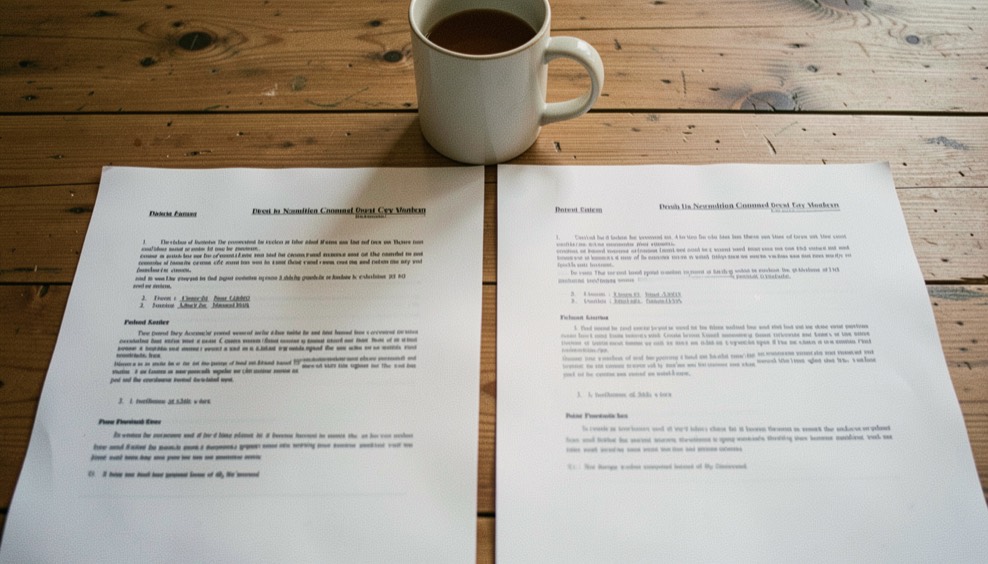
A song leaves more paper than sound. Theatre programmes, session sheets, tape boxes and pressings record dates, rooms, personnel and sequence numbers that a sleeve note never carries, and those documents are what allow a recording to be checked years later. The material archive is not nostalgia: it is the evidence layer under the music.
The the Four Lads archive treats that layer as its subject, covering touring paperwork, recording documentation and the storage of records and covers. What follows is a practical reading of what each document type holds and how it survives.
What do theatre programmes and session sheets record that a sleeve note does not?
A sleeve note is written to be read after the fact, usually by someone with an interest in the finished record. A theatre programme is written before the fact, for an audience that needs to know who is on stage and when. That difference in purpose produces different information.
A programme typically carries the date and the venue, the running order, the names of the performers and often the supporting acts, the conductor or musical director, and the times of the two halves. It may list the local promoter, the theatre's own staff, and the prices. None of this is guesswork: it is printed for the night in question, which makes it a dated object. Two programmes from the same tour, one from a Tuesday and one from a Saturday, can show a change of personnel or a dropped number that no studio document would mention.
A session sheet works the other way. It is an internal record of a working day in a room: the date, the studio, the start and finish times, the names of the musicians and engineers present, the titles attempted, and the number of takes. It often notes which take was marked for use, and sometimes why. A sleeve note may say that a song was recorded in a particular year; a session sheet can say that it was recorded on a specific afternoon, that the fourth take was kept, and that a second guitarist arrived late. For anyone checking a claim about a recording, the session sheet is the closer document.
The two types of paper answer different questions. The programme answers who was heard, where and when. The session sheet answers who played, how many attempts were made, and which attempt survived.
How are tape boxes and pressings stored so the covers survive?
Storage is a set of small decisions repeated over years. The aim is to keep the object stable and to keep handling away from the surfaces that damage most easily.
Tape boxes are usually stored upright, like books, rather than stacked flat. Flat stacking puts weight on the box and on the reel inside, and it makes the box harder to remove without pulling. Upright storage in a shelving unit that is not overfilled allows a box to be lifted out by its edges. The box itself is kept closed and, where the original slipcase exists, the reel stays inside it. Temperature and humidity are kept steady rather than low: a stable room is kinder than a cold one that swings. Light is kept off the spines, because printed labels fade.
Records are stored vertically for the same reason. A shelf of LPs leaning at an angle will warp the ones at the ends; a shelf packed too tightly will scuff the covers every time a record is pulled. The usual arrangement is a row that is firm but not compressed, with a divider every so often so that the row does not lean. Inner sleeves are replaced only when the original is causing damage, and the original is kept with the record rather than discarded, because it is part of the object.
Covers take the most handling, so they get the most attention. A record is removed from its cover by holding the cover with both hands and letting the disc slide out, rather than gripping the cover by one corner. Outer sleeves, if used, are changed when they become cloudy. Ring wear, seam splits and corner bumps are recorded rather than repaired, because a repair changes the object and hides the evidence of how it was kept.
What identifies a pressing once the label is worn?
A worn label removes the easiest identifier, so identification moves to the object itself. The first place to look is the run-out area, the smooth band between the last groove and the label. Most pressings carry a matrix number stamped or hand written there, often with a stamper or mother code and sometimes a plant identifier. These marks survive label wear because they are pressed into the vinyl rather than printed on paper.
The second place is the label's remaining structure. Even when the print has gone, the label may retain its shape, its paper texture, its ring, and the position of the spindle hole relative to the printing. A label with a deep ring impression and a wide margin is not the same object as one with a narrow margin, and the difference can separate two editions of the same title.
The third place is the cover. Printing codes, catalogue numbers, price stickers, import marks and the address printed on the back can all narrow a pressing to a country and a period. A cover that has been kept with its record since new is stronger evidence than a cover matched to a disc later.
Finally, weight and edge profile help. A disc that is heavier than a later edition, or that has a different edge, is a different pressing even when the label looks identical. The practical method is to record all of these observations together: matrix, label structure, cover printing, weight. No single mark is conclusive, but the combination usually is.
Why keep the paperwork at all?
Because the paperwork is the part that can be checked. A memory of a concert, a claim in a note, a dealer's description: each of these can be tested against a dated programme, a session sheet, a tape box label or a matrix number. The archive exists so that the test is possible.
That is also why the documents are stored with the same care as the records. A programme kept flat, dry and out of light remains readable. A session sheet kept in a folder with its related papers remains usable. A tape box kept upright with its reel inside remains a box with a label, not a pile of card. The material archive is not a collection of souvenirs; it is a working reference, and it works only if the objects are still legible when someone finally needs to ask them a question.